
01
Budget-Friendly Pricing
Advanced WordPress development at a price that makes sense. We offer clear, flexible packages built around your budget, with no hidden costs.
Is your WordPress site slower than it should be? We track down the cause and sort it out, so your pages load quickly, your Core Web Vitals improve and visitors stay longer.
Speed isn't a technical detail. It's directly connected to how your business performs online.
A slow first impression sends people back to search results before they ever see what you offer.
Core Web Vitals are a ranking factor. A slow site works against your own SEO, not just your visitors.
Every extra second of load time is another chance for a visitor to abandon an enquiry, cart or booking.
Slow, janky pages feel unreliable, and that impression carries over to how people see your business.
Most agencies only touch your code. We go further, into the server environment your site actually runs on.
We go into your theme, plugins and database, not just the surface settings.
Most agencies stop at code. We go into the hosting environment itself.
A site that's fast on paper but slow on real hosting isn't actually fast. We fix both sides of the equation.
We measure how quickly your website loads, responds to visitors, and stays stable while the page loads. These are the signals Google uses to assess real user experience.
How quickly the main content becomes visible to a visitor.
How quickly the website responds when someone clicks, taps, or types.
How much the page moves unexpectedly while it loads.
These measurements are part of Google's Core Web Vitals and help us identify where your website needs improvement.
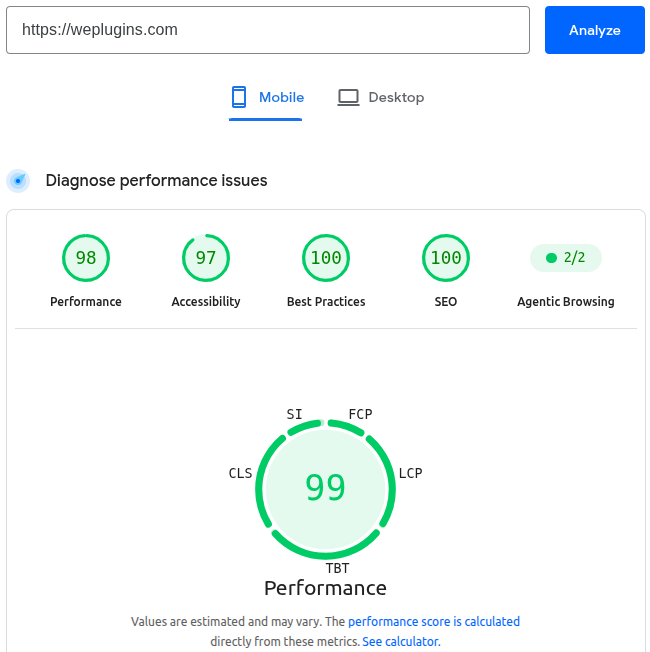
A full pass across the areas that actually determine how fast your site feels and how well it scores.
Compression, modern formats and correct sizing across every device.
Removing bloat that builds up in WordPress over time and slows every query.
Page, object and browser caching configured correctly for your specific setup.
Identifying what's actually slowing you down, and what can be removed or replaced.
Serving assets from locations close to your visitors, wherever they are.
Tested and tuned for real mobile networks and devices, not just desktop.
Reducing TTFB at the hosting level, where a lot of speed is won or lost.
Cleaning up render-blocking JavaScript and CSS that delays what visitors see.
We work to take every site we optimise to its maximum realistic potential. Our average PageSpeed score across projects is 94.
A structured process across both code and server, so nothing gets missed and results are measurable.
We run a full technical audit of your site, covering Core Web Vitals, code and server configuration.
We identify the specific causes of slow load times, not just symptoms, and prioritise fixes by impact.
We optimise theme and plugin code, database queries, images and asset delivery.
We tune caching, server configuration, PHP and CDN setup at the hosting level.
We measure results against Core Web Vitals and PageSpeed, across real devices and connections.
Performance can drift as content and plugins are added. We can monitor and keep your site fast over time.
From transparent pricing to expert, responsive support — here's what you can expect when you work with WePlugins.
Advanced WordPress development at a price that makes sense. We offer clear, flexible packages built around your budget, with no hidden costs.
You're never left waiting. Our team responds quickly and keeps you informed at every stage, so questions get answered and issues get resolved fast.
Our team has delivered WordPress projects across a wide range of industries, bringing proven expertise to every plugin, theme and website we build.
Get a full code-level and server-level speed audit, with a clear, prioritised plan to fix what we find.
